
CENER’s HYDROGEN AREA deals with the analysis and development of the entire green or renewable hydrogen value chain, including techno-economic studies, plant designs and adaptable control systems. At the technological development level, the department focuses on one of the key technologies for H2 production and use (solid oxide electrolyzers and fuel cells), both from an experimental (HyGrIn Lab-innovation for Green Hydrogen) and theoretical (multi-scale modeling) point of view.
Hydrogen is set to play a key role in the future energy system based on renewable energies. The conversion of electrical energy from renewable production peaks into chemical energy in the form of hydrogen (or derivatives), not only makes the system more flexible through energy storage for later use, but in a key way addresses the decarbonization of sectors that are difficult to electrify, such as heavy transport or key industries such as steel.
CENER contributes to the consolidation of hydrogen as a real alternative, technologically and economically viable, through the following specific activities:
- Development of technologies for the production and use of green H2:
- Cells and stacks manufacturing: processed at pilot plant level.
- Electrochemical and structural characterization and validation of cells and cell components.
- Advanced stack and system designs, by means of multi-scale modeling.
- Techno-economic studies of the entire H2 value chain.
- Production plant design: techno-economic analysis, process diagram, equipment design and power electronics.
- Ad-hoc plant control systems, adaptable to project and/or client requirements.
The Hydrogen Area is composed of a multidisciplinary team that includes chemists, physicists and engineers from different backgrounds, which allows covering the entire spectrum of technological development of systems, from optimization and integration of materials at the cell level, to scaling manufacturing and design of plug-&-play systems. With a clear vision of prototyping, the Area has unique infrastructures, forming a unique Hydrogen laboratory for the integration and validation of production technologies at pilot plant level.
- Sub-area: Materials integration and scaling
- Sub-area: System and plant design
- Sub-area: Control systems
- Sub-area: Techno-economic studies

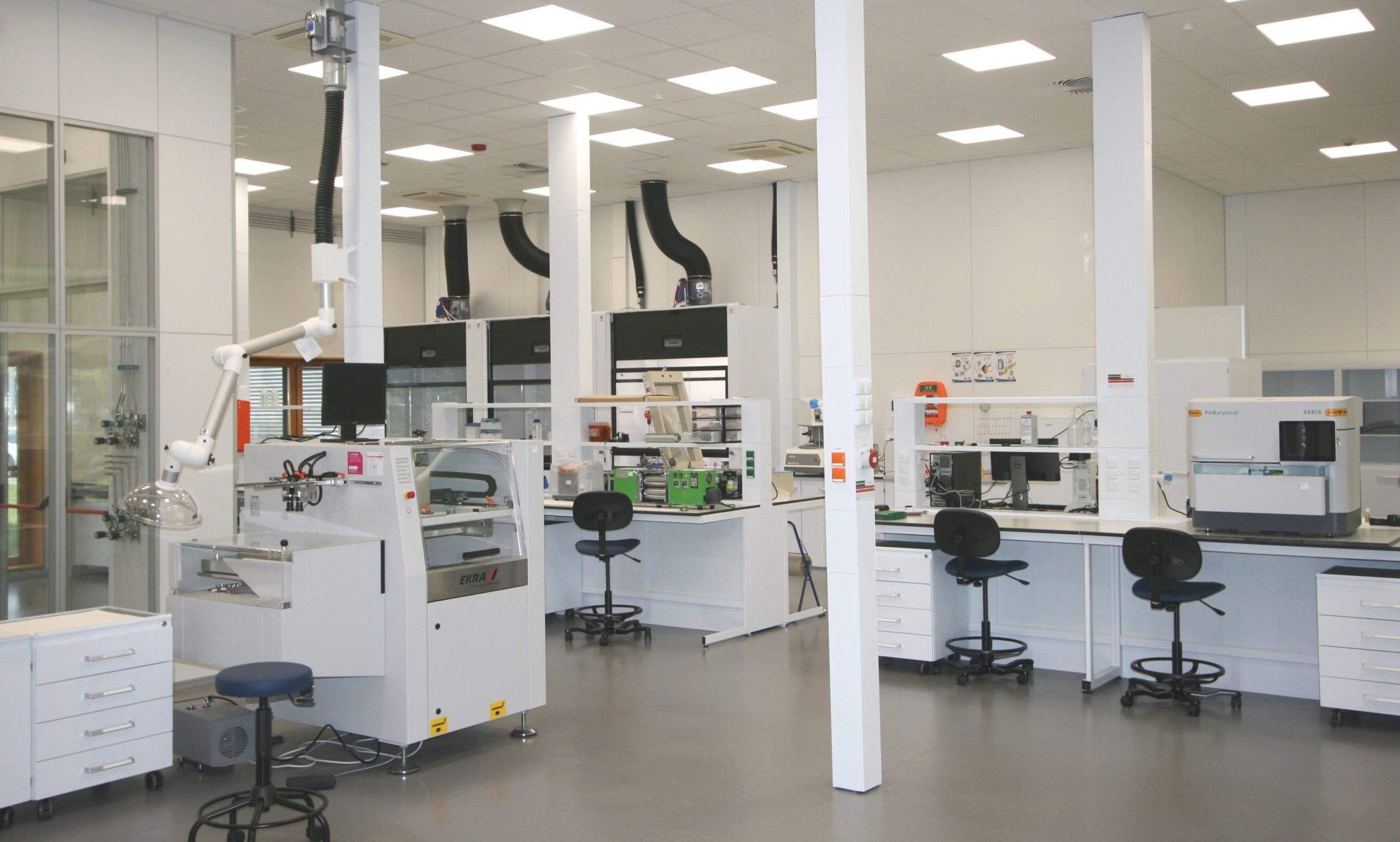
HYDROGEN LABORATORY
HyGrIn Lab – Innovation for Green Hydrogen is a multipurpose laboratory, which has state of-the-art equipment with which it is possible to carry out a comprehensive development of devices for the production and use of green hydrogen, both at high and low temperatures.
Located at CENER facilities in Sangüesa (Navarre-Spain) and with a total area of 300 m2, it is structured in the following unique areas:
- Area of materials. Area dedicated to the preparation, optimization and processing of functional materials for hydrogen technologies. It includes all necessary equipment for the preparation and homogenization of inks, pellet pressing, laminate casting, drying and sintering at high temperatures.
The area also includes a series of equipment for structural and mechanical characterization of processed materials and cell components: viscometer, optical microscope, scanning electron microscope, X-ray diffractometer, profilometer and particle size analyzer.
- Area of upscaling. It includes the necessary equipment to manufacture at pilot plant scale complete prototypes for the production and use of green hydrogen (e.g. cells and stacks for electrolysers and/or fuel cells).
In particular, the area comprises a roll-to-roll tape casting equipment for the preparation laminates, as well as a screen printing equipment. Likewise, it contains other additional equipment for the manufacture of cells and stacks (e.g. puncher, welding maching…).
- Electrochemical testing area. Area focused on the electrochemical characterization of cells and stacks for green hydrogen production and use. It includes multi-scale test stations, highlighting the testing capacity from small cells at the laboratory level (from the order of mW to a few W), to full-scale cells (sizes up to 10×10 cm2) and finally prototype-level stacks, up to 10 kW.
This hydrogen laboratory has been financed by:


(*Included the Ministry of Science and Innovation (Government of Spain) and by the Department of University, Innovation and Digital Transformation (Government of Navarra)).