
TESTING OF SOLAR CLEANING ROBOTS – an opportunity to improve the O&M of large Photovoltaic installations.
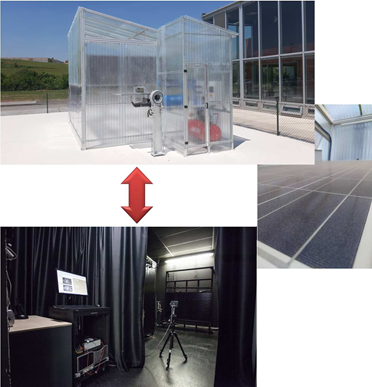
CENER is always at the forefront to support its clients in their needs either in the short term (tests, product certifications, audits, quality control…), and in the medium-long term, through applied research and innovation, which aims to provide solutions to the challenges posed by the market and society.
In the field of solar cleaning robots or systems for photovoltaic modules, we are faced with a need that the photovoltaic market manifests imminently, but which, on the other hand, requires certain innovative components that must be resolved beforehand. Let’s see some details below.
In cooperation with an important IPP (Independent Power Producer) of photovoltaic energy that operates plants in several countries around the world with very diverse climatic and soil conditions, CENER began to think about the key factors that influence the cleaning of photovoltaic modules with robotic or automated systems. The first question that arose was, to what extent the cleaning robots can affect or damage the surface layers of the PV module or even if they can, after hundreds of passes, end up causing damage that significantly alters photovoltaic generation.
Factors such as the mineral composition of the soiling or dirt, the hardness of the brushes, the use or not of water… were taken into account when proposing the optimal methodology that determines if the cleaning systems can damage the modules and under what conditions of operation.
On the other hand, CENER’s vast experience as a photovoltaic module testing laboratory made it possible to develop a methodology that provided an empirical answer to the question raised in the previous paragraph. The reflectance tests, as well as the power measurement under standard conditions and electroluminescence, among others, are part of the initial and final characterization sequences (and in some cases, intermediate characterizations) applied to the modules that have been subjected to prolonged action of robotic cleaning systems in the time. In this way we will be able to verify, for example, the degradation of the anti-reflective layer or the possibility of having generated cracks in the cells due to mechanical stress.
But… how do we reproduce the prolonged action of the cleaning systems over the modules? The facilities are intended to be operated for 25 years or more. Furthermore, how can we keep the testing conditions stable? Quantity and granulometry of the soiling, water amount, number of cycles… To carry out a practical term of the methodology, CENER designs, installs and starts up its own bench for testing cleaning systems. Mentioned bench makes it possible to keep the test conditions under control and carry out accelerated soiling-cleaning cycles, that is, replicating the client’s cleaning guidelines for the the installation lifespan, but in a reasonable period of time. One of the keys of CENER´s test bench lies in the “application of dirt”, by means of a diffusion system that generates a dusty atmosphere in a semi-closed space, which is distributed by gravity on the surface of the modules.
CENER continues to carry out these types of tests both for IPPs and for manufacturers of cleaning systems and is prepared to continue innovating in the aspects related to the Operation and Maintenance of photovoltaic installations hand in hand with its collaborators and clients.