
Scalable fabrication routes and smart designs for advanced solid oxide electrolysers (SOEC)
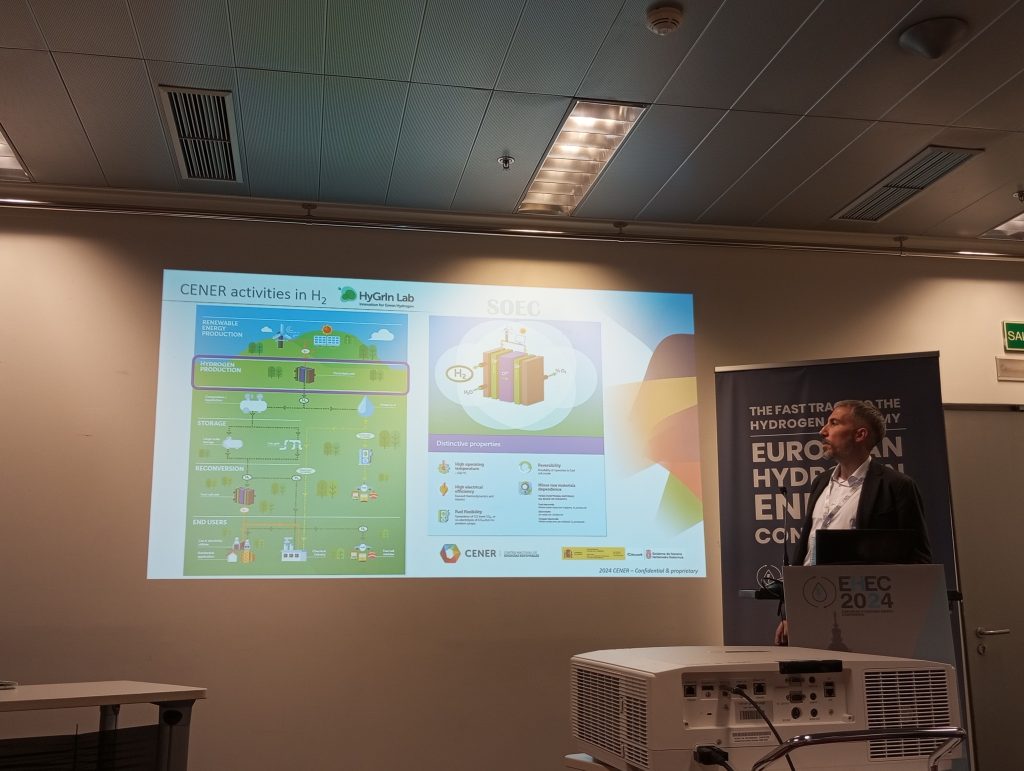 Our CENER colleague Íñigo Garbayo Senosiain, Hydrogen Area Responsible has taken part in the Parallel Session European Hydrogen Energy Conference taken place in Bilbao 6th, 7th and 8th of March at the Bilbao Exhibition Centre. The title of his communication has been Scalable fabrication routes and smart designs for advanced solid oxide electrolysers (SOEC)”.
SOEC technology in the frame of Renewable Hydrogen Generation is making its way as an attractive solution mainly for those “hard to abate” sectors that produce a great amount of heat that can be used to get higher efficiencies in the electrolysis process.
This is CENER technology choice for their developments and the one the group of Dr Garbayo is working on. Their goal is the construction of 2 kW SOEC prototype electrolyser and a system using renewable hydrogen based on a 10 kW SOEC Fuel Cell. In this regard CENER Hydrogen Area has an integral vision of this technology development and is willing to provide contribution to the four fundamental levels required to consolidate it as a true alternative at industrial level: (i.) scalable manufacturing of electrolytic cells, (ii.) stacks advanced designs (iii.) efficient systems building and (iv.) final integration in real environments.
As in every electrolysis technology, SOEC functional unit is the electrolytic cell. CENER facilities in Sangüesa harbour a cell manufacturing chain, currently at a testing stage. These cells are manufactured with non-critical materials, so their final price does not increase CAPEX in a significant manner. Functional printing and sintering processes are being employed in the manufacturing.
Our electrolytic cells have an approximate current size of 5×5 cm2, although they can be manufactured for other dimensions. The hydrogen quantity they can produce is, consequently, very small. This is why, in any process of this nature cells are located and connected one on the other (stack). Several tenths of cells can deliver a significant quantity of hydrogen. These stacks, in SOEC technology, must be provided with a perfect sealing among cells and a homogeneous gas distribution within the whole structure. Given the high temperatures at which the reaction occurs it is a key aspect to avoid overheated areas because degradation of the device would be accelerated in that case. A key component inside the stack is the interconnection plate. CENER is already working on and manufacturing according to optimized designs to allow homogeneous connection among cells.
In the framework of designing and constructing an electrolysis system BoP (Balance of Plant) refers to all the engineering around the stacks in the electrolyser which enables its performance (piping, valves, gas pressure and temperature managing, electronics, etc). CENER owns modelling software which allow us to know the performance and efficiency of our designs at the construction stage by modelling any part of the device before this phase takes place. Furthermore, we work in these prototypes manufacturing as we as in its validation in controlled environments. All this is possible thanks to our facilities ATENEA designed for equipment testing up to 1 MW.
PNIEC proposes very ambitious figures for Spanish hydrogen production in 2030. This will force the industry to reduce the deadlines when technological developments will reach the market.
During the last months we have been aware of very important hydrogen projects suffering important delays and interruptions due to unexpected problems appearing during the start-up phase. In order to minimize any type of risks, once the installation of these types of equipment occurs at big scale, we consider of key importance to have tested these technologies in controlled environments as close as possible to the real working conditions. CENER offers the industry our Microgrid Atenea for any type of testing performance to be able to face future problems. These problems can be created by materials long term degradation, unwanted effects on the electric system and networks, etc.