CENER IS MOVING FORWARD IN DECARBONIZING MARITIME TRANSPORT WITH NEW DEVELOPMENTS IN SOLID OXIDE ELECTROLYSIS
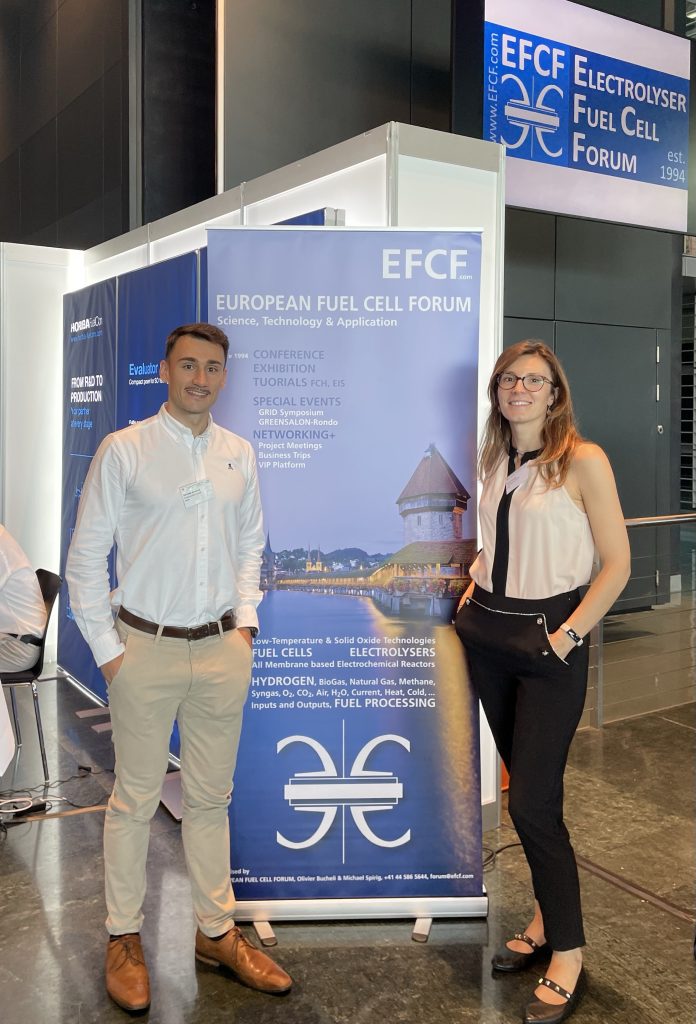 From July 1–3, Dr. Paula Ciaurriz Gortari and Dr. Gonzalo Jiménez Martín, researchers at the National Renewable Energy Centre (CENER), will participate in the Electrolyzer and Fuel Cell Forum 2026 (EFCF 2026) in Lucerne, Switzerland. The conference brings together leading international experts from research institutions and industry to share the latest advances in fuel cells, high-temperature electrolyzers, and Power-to-X technologies.
As part of the technical program, Dr. Paula Ciaurriz Gortari will deliver an oral presentation entitled “Scale-up of Solid Oxide Cell Fabrication: From Laboratory Optimization to Pre-industrial Manufacturing”. Her presentation will highlight CENER’s progress in scaling up the manufacturing of solid oxide cells, bridging the gap between laboratory-scale optimization and pre-industrial production. The contribution focuses on the potential effects of scale-up processing on cell properties and functionality, demonstrating the feasibility of roll-to-roll manufacturing using water-based formulations, which are more environmentally friendly than the solvent-based systems currently employed in industry. Furthermore, the paper presents improvements in several cell components (particularly the oxygen electrode) and the scale-up of the cell size to 10 × 10 cm², both of which were developed within the framework of the SOFCOMPACT project (PRH2CVAL4-C2-2023-000045), funded by the European Union – NextGenerationEU, Recovery, Transformation and Resilience Plan. 

In addition, Dr. Gonzalo Jiménez Martín will present a poster entitled “Advances in the Production of Low-Carbon Methanol for Transportation via Solid Oxide Co-Electrolysis: Feasibility Results from the COMECOCO2 Project”. The poster will showcase the latest developments achieved by CENER within the COMECOCO2 project (PLEC2024-011072, funded by MICIU/AEI/10.13039/501100011033/FEDER, EU). This project aims to develop an innovative Power-to-Liquid technology for producing renewable methanol from renewable electricity, water, and captured CO₂. The renewable methanol produced is intended to be used as a sustainable marine fuel, contributing to the decarbonization of one of the most challenging sectors to electrify. The proposed solution integrates a catalytic reactor with a solid oxide co-electrolysis system, using reclaimed water and CO₂ captured from a wastewater treatment plant. The project follows a comprehensive approach, covering the development of materials and components through to the design, construction, and validation of a prototype under real operating conditions. This contribution will present the preliminary results of the techno-economic feasibility assessment of a methanol production plant based on the technological concept developed within the project.